Walk into many South African dental practices and you'll still find a paper chart on the counter: a printed tooth diagram, a pen, and handwritten notes that someone later retypes into a claim. It works, until a code is misread, a file goes missing, or a medical aid rejects a claim over a wrong tooth number.
This guide explains what every SA practice needs to know about dental charting: how SADA procedure codes and ICD-10 codes connect your chart to medical aid claims, what the HPCSA and POPIA expect from your records, and how paper and digital charting compare in day-to-day practice, with a look at how StazaCare tackles each problem along the way.
Why the dental chart matters
The dental chart is the single record that ties together what you found, what you did, and what you bill. It does three jobs at once:
- Clinical: it shows the current state of every tooth (restorations, missing teeth, caries, planned work) so any clinician can pick up the patient's care.
- Legal: it is part of the patient's health record, which you are required to keep accurately and securely.
- Financial: every procedure code and tooth number on a medical aid claim should trace back to an entry on the chart. If the chart and the claim disagree, the claim is at risk.
Accuracy is where paper charts fall down. In a UK audit of 1,128 general dental practice records, 14 dentists reviewing the charts of patients who were new to them found that 44% of the charts were inaccurate (Brown & Jephcote, Dental Update, 2017). The authors point to the regulatory requirements and the forensic importance of an accurate chart.
How StazaCare helps
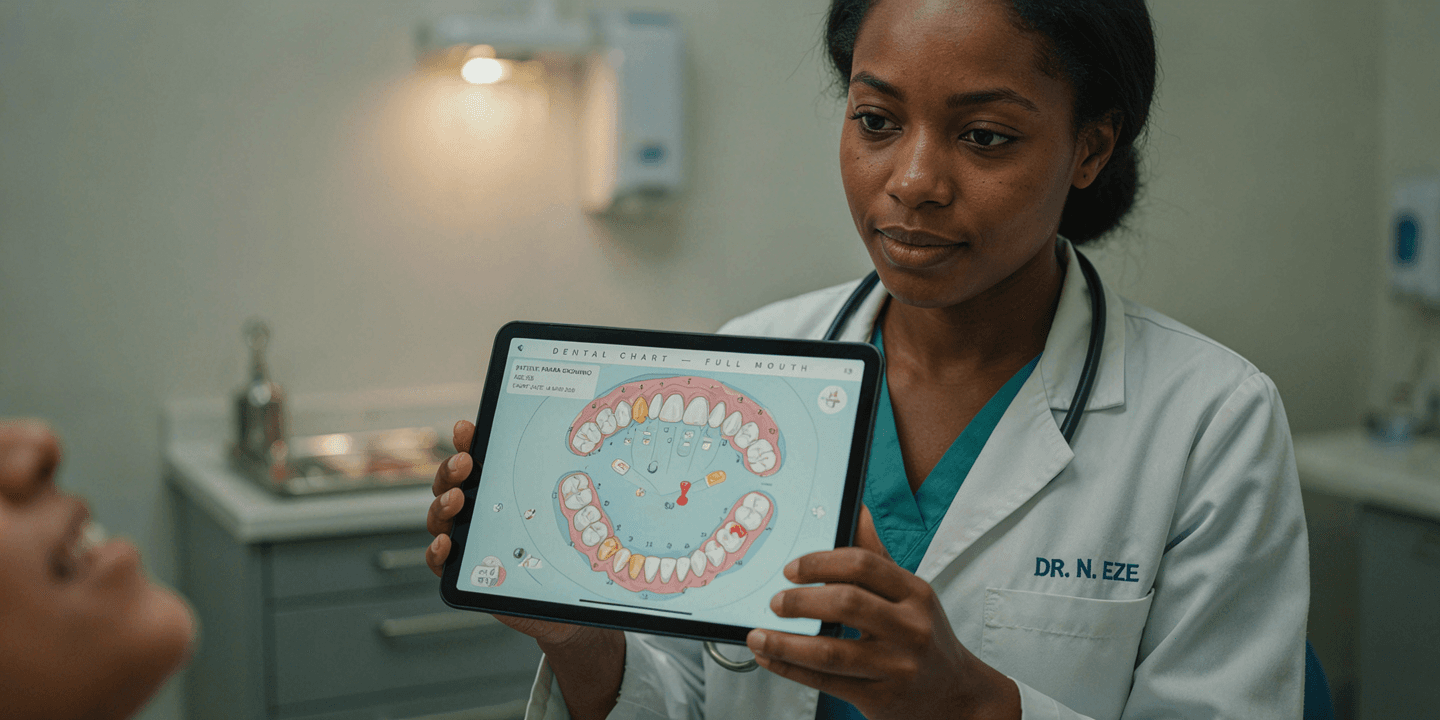
StazaCare keeps the clinical, legal and financial jobs in one record. The dentist charts on an interactive FDI chart by clicking the tooth, so the correct tooth number is recorded every time, with no left–right mix-ups or transposed digits, and the same entry feeds the patient file and billing.
SADA codes and ICD-10: how the chart becomes a claim
A medical aid claim for dental work needs three things to line up: what you did (a SADA procedure code), where you did it (an FDI tooth number, for tooth-specific procedures), and why you did it (an ICD-10 diagnosis code).
- SADA procedure codes are the four-digit codes the South African Dental Association publishes for dental services. For example, 8101 is an oral examination, 8155 is polishing of the complete dentition, and 8159 is prophylaxis of the complete dentition (code list).
- ICD-10 codes give the diagnosis behind each line. SADA publishes a quick-reference ICD-10 coding guide for dentists, and some codes require a supplementary code to be valid.
A worked example from the SA Dental Journal shows how a single visit becomes coded lines: an examination (8104) with ICD-10 Z01.2, then removal of a residual root (8213) on tooth 43, paired with its own diagnosis codes.
On paper, someone has to translate the chart into these codes after the patient leaves, which is where most mistakes happen. When charting is digital, the procedure is recorded against the tooth with its SADA code as the dentist works, and the claim line is built from that same entry.
How StazaCare helps
In StazaCare, the dentist selects the tooth on the FDI chart and records the procedure with its SADA code at the chair. Because the chart and billing share the same record, reception bills from what was charted instead of retyping it, so the tooth number and procedure code on the claim match the chart.
Paper vs. digital charting at a glance
| Paper charting | Digital charting | |
|---|---|---|
| Tooth numbering | Handwritten; left–right and transposed-digit errors | Click the tooth; FDI number recorded automatically |
| Procedure codes | Looked up and added later, often by reception | SADA code attached to the tooth at the chair |
| Legibility | Depends on handwriting | Always readable |
| Claims | Retyped from the chart; mismatches cause rejections | Claim lines built from the chart entry |
| Treatment history | Flip through pages or several files | Full history per tooth on one screen |
| Corrections | Must be dated, signed and explained by hand | Amendments logged with user, date and time |
| Security and POPIA | Locked cabinets; hard to control who sees what | User logins, access roles, encrypted storage |
| Backup and disaster | Fire, flood or a lost file means lost records | Cloud backup; records survive a damaged laptop |
| Storage | Filing space grows every year | No physical storage |
| Upfront cost | Low | Monthly subscription |
Paper still wins on upfront cost and familiarity. Digital wins on nearly everything that affects claims, compliance and time at reception.
Research backs this up. In a 2025 comparative study, 200 dental patient records were randomly assigned to paper or electronic format and reviewed by 20 dental students (Scarano et al., BioMed Research International). Students using paper records overlooked 24 cases of antiresorptive medication use, six patients on anticoagulant therapy and one penicillin allergy; students using electronic records had no oversights. Finding the relevant history took about two minutes of reading per paper record, and compiling an implant report from paper took 112 minutes for initial registration plus another 213 minutes to complete, against near-instant report generation from the electronic records. The authors also note the trade-off: software, training and support costs can slow adoption.
How StazaCare helps
StazaCare shows each tooth's full treatment history on one screen, so nobody has to page through old folders to find what was done before. Records sit in secure cloud storage rather than a filing cabinet, so they survive a fire, a flood or a damaged laptop, and there is no filing space to outgrow.
What the HPCSA and POPIA expect
The HPCSA's Booklet 9: Guidelines on the keeping of patient records sets the rules your chart has to meet, whether it's paper or digital:
- No erasing. Nothing may be removed from a health record. Paper records should be kept in non-erasable ink with no correction fluid.
- Corrections are traceable. Later additions must be dated and signed in full, and the reason for any amendment recorded.
- Keep records for a long time. The HPCSA prefers that records be kept indefinitely, ideally electronically; where that isn't feasible, the minimum is six years after the record goes dormant (summary). For minors, keep records until at least the patient's 21st birthday (MedicalBrief).
POPIA treats health information as special personal information, so the practice must protect it against loss and unauthorised access. MedicalBrief notes that POPIA, the National Health Act and the HPCSA all point the same way: keep health records, and keep them secure.
Paper can meet these rules, but it takes discipline. A digital system with access controls, audit trails and backups makes compliance the default.
How StazaCare helps
StazaCare stores patient records in secure cloud storage designed with POPIA in mind, protecting health information against loss and keeping it off the front counter. Because every chart entry, the patient file and billing live in one record, the history the HPCSA expects you to keep for six years or more is in one place, with no physical archive to manage.
Moving from paper to digital: 5 practical steps
- Start with new patients and active files. You don't need to digitise every archived folder on day one.
- Chart current status at the next visit. When an existing patient comes in, capture their full dentition on the digital chart during the exam.
- Scan and attach old paper records. Keep the originals as required, and attach scans so history is one click away.
- Train the whole team together. Dentist, assistant and reception should all learn how charting feeds billing.
- Run paper and digital side by side for two weeks. Then switch fully once the team is confident.
Ready to retire the paper chart? Book a free StazaCare demo and see digital charting on your own patient workflow.
Frequently asked questions
What are SADA codes?
Four-digit procedure codes published by the South African Dental Association, used to bill dental services to medical aids.
Do dental claims in South Africa need ICD-10 codes?
Yes. Each procedure line on a claim should carry an ICD-10 diagnosis code alongside the SADA procedure code.
How long must a dental practice keep patient records?
The HPCSA recommends keeping records indefinitely, ideally electronically, with a minimum of six years after the record becomes dormant. For minors, keep them until at least age 21.
Is digital charting POPIA compliant?
It can be, if the system uses secure logins, role-based access, encryption and backups. Check these features before choosing software.
Sources
- HPCSA Booklet 9: Guidelines on the keeping of patient records
- MedicalBrief: Who owns the right to a patient's health records?
- SADA ICD-10 Coding Guide and Reference
- SADJ: ICD-10 coding case examples
- Conservative dentistry code list
- Brown & Jephcote: Inaccurate dental charting in an audit of 1128 general dental practice records (Dental Update, 2017)
- Scarano et al.: A digital clinical records versus paper records in dental practice: a comparative study (BioMed Research International, 2025)